

Sarkopenie diagnostiziert: Warum 0,8 Gramm Eiweiß pro Kilo oft zu knapp sind
Wenn Sarkopenie bereits festgestellt ist, reichen 0,8 Gramm Eiweiß pro Kilo Körpergewicht wahrscheinlich nicht. Studien deuten eher auf 1,2 bis gut 1,5 Gramm hin. Die Belege sind teils klein, und die Nieren sollten vorher ärztlich geprüft werden.
Wahrscheinlich nicht. Wenn bei Ihnen Sarkopenie festgestellt wurde, deuten mehrere Studien auf einen höheren Bedarf als 0,8 Gramm Eiweiß pro Kilo Körpergewicht hin. Eine kleine Messstudie mit neun Betroffenen ermittelte einen durchschnittlichen Bedarf von 1,21 g/kg und eine Empfehlung von 1,54 g/kg pro Tag. In einem randomisierten Versuch mit 126 Frauen führten 1,2 g/kg zu mehr Muskel und mehr Kraft als 0,8 g/kg. Die Belege sind ermutigend, aber noch schmal. Lassen Sie vor einer Umstellung Ihre Nieren ärztlich prüfen.
Weiterlesen mit Premium
Der Rest dieses Beitrags gehört zum Premium-Paket für 29,00 € im Monat. Darin enthalten sind 76 weitere Beiträge, alle Programme und Webinare zum Mitgliederpreis.
Jederzeit kündbar. Die Kernaussagen unten bleiben frei lesbar.
Kernaussagen — auch ohne Abo
- Bei diagnostizierter Sarkopenie liegt der gemessene Bedarf in einer kleinen IAAO-Studie (n = 9) bei 1,21 g/kg, die Empfehlung bei 1,54 g/kg pro Tag.
- In einem 12-Wochen-RCT mit 126 Frauen brachten 1,2 statt 0,8 g/kg mehr Muskelquerschnitt im MRT und mehr Griffkraft.
- Ältere Koreaner unter 0,8 g/kg hatten häufiger Sarkopenie (OR 1,79 gegenüber ≥ 1,2 g/kg) – ein Zusammenhang aus Beobachtungsdaten.
- Beispiel 70 kg: 56 g bei 0,8, 84 g bei 1,2, rund 108 g bei 1,54 g/kg.
- Vorher Nieren ärztlich prüfen lassen und Krafttraining einplanen.
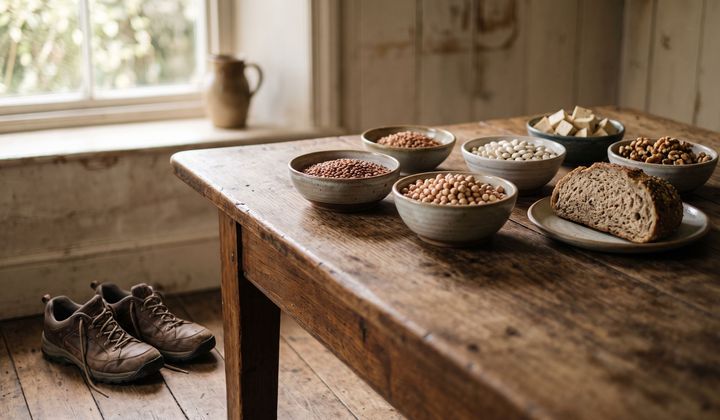 Vertiefen Darf das Eiweiß bei Sarkopenie auch aus Hülsenfrüchten und Nüssen kommen?
  Nächster Schritt Wie oft, wie schwer und wie lange sollte ich bei Muskelschwund trainieren?
  Querverbindung Bringt Kreatin zum Krafttraining ab 60 wirklich mehr Kraft und Muskeln?
 Ähnliche Beiträge




Belege (4)
Open-Access-Publikationen mit offener Lizenz, direkt verlinkt.
Dietary protein requirements of older adults with sarcopenia determined by the indicator amino acid oxidation technology
Abstract
<h4>Background</h4>Although protein supplementation may be desirable in the management of sarcopenia, the appropriate protein requirements for older adults with sarcopenia are presently unclear.<h4>Objective</h4>The aim of this study was to determine the protein requirements of older adults (65-81 year) with sarcopenia by using the indicator amino acid oxidation (IAAO) technology.<h4>Methods</h4>Nine older adults with sarcopenia (four male participants and five female participants) participated in the study, with protein intakes ranging from 0.1 to 1.8 g/(kg·d). Each participant consumed an adapted diet with a protein level of 1.0 g/(kg·d) and 1.7 resting energy expenditure (REE) for 2 day. Day 3 was the oxidation day of the study. Diets that delivered energy at a 1.5 × REE were isocaloric. The amounts of phenylalanine and tyrosine maintained at a constant across intakes. Therefore, phenylalanine and tyrosine were added to the protein doses of 0.1-1.5 g/kg, which was based on the highest dose of lactalbumin content [1.8 g/(kg·d)]. Applying a non-linear mixed-effects model analysis of F<sup>13</sup>CO<sub>2</sub>, the protein requirement was determined by identifying the breakpoint in the F<sup>13</sup>CO<sub>2</sub> data with graded amounts of dietary protein.<h4>Results</h4>The mean estimated average requirement (EAR) and recommended nutrient intake (RNI) of protein for older adults with sarcopenia were 1.21 (95% CI: 0.95, 1.46) and 1.54 (95% CI: 1.13, 1.95) g/(kg·d), respec
Role of protein intake in maintaining muscle mass composition among elderly females suffering from sarcopenia
Abstract
Dietary protein is crucial in preserving muscle mass and promoting long-term bone health, particularly in aging populations. The novelty of this study lies in evaluating the impact of varying protein intake levels (0.8 vs. 1.2 g/kg b.w/d) on muscle mass composition in elderly females suffering from sarcopenia. For this purpose, in this research trial, a total of 126 participants (60-75 years) were enrolled and equally divided into two groups: normal protein intake (0.8 g/kg b.w/d) and moderately high protein intake (1.2 g/kg b.w/d) for 12 weeks. The effects of dietary protein were assessed using anthropometric measurements, magnetic resonance imaging (MRI), handgrip, and knee flexion tests with baseline and post-intervention comparisons. Statistical analysis was conducted using SPSS, employing paired sample t-test at a significance level of <i>p</i> < 0.05. Results indicated a significant improvement in muscle mass composition with moderately high protein intake. Anthropometric parameters, including body mass (83.51 ± 4.23 kg) and waist circumference (113.90 ± 10.82 cm), showed notable enhancement in the moderately higher protein group. Muscle function and imaging assessments, such as handgrip strength and knee flexion, demonstrated improved functionality. MRI-derived measurements of the muscle composition of the calf (141.23 ± 4.87 MCSA, mm<sup>2</sup> × 10<sup>4</sup>) and thigh (258.04 ± 7.26 MCSA, mm<sup>2</sup> × 10<sup>4</sup>) further confirmed the positive impact of i
Association of Protein Intake with Sarcopenia and Related Indicators Among Korean Older Adults: A Systematic Review and Meta-Analysis
Abstract
<h4>Objectives</h4>Due to variations in the standards for optimal protein intake and conflicting results across studies for Korean older adults, this study aimed to quantitatively integrate existing research on the association of protein intake with sarcopenia and related indicators in Koreans aged 65 and older through meta-analysis.<h4>Methods</h4>A total of 23 studies were selected according to the study selection criteria (PICOS). Sixteen cross-sectional studies, 5 randomized controlled trials (RCTs), and 2 non-RCTs were included in the review, with 9 out of 23 studies included in the meta-analysis. We used fixed-effects models and performed subgroup and sensitivity analyses.<h4>Results</h4>A meta-analysis found that the risk of sarcopenia was significantly higher in the <0.8 g/kg/day protein intake group compared to the 0.8-1.2 g/kg/day and ≥1.2 g/kg/day groups, with odds ratios (ORs) of 1.25 (95% confidence interval (CI), 1.10 to 1.42; <i>I</i><sup>2</sup> = 55%) and 1.79 (95% CI, 1.53 to 2.10; <i>I</i><sup>2</sup> = 71%), respectively. For low hand grip strength (HGS), the risk was higher in the <0.8 g/kg/day group compared to the 0.8-1.2 g/kg/day or ≥1.2 g/kg/day groups (OR 1.31; 95% CI, 1.03 to 1.65; <i>I</i><sup>2</sup> = 28%). No significant associations were found with other sarcopenia indicators, such as skeletal muscle mass, short physical performance battery score, balance test, gait speed, and timed up-and-go test.<h4>Conclusions</h4>Lower protein intake is ass
Investigating muscle protein synthesis using deuterium oxide: The impact of dietary protein interventions across the lifespan
Abstract
This review highlights recent advancements in our understanding of muscle protein synthesis (MPS) across the lifespan, with a focus on dietary protein strategies to support muscle health. Given that skeletal muscle is crucial for whole-body metabolism, movement and independence, maintaining muscle mass throughout life is essential. However, the gradual decline in muscle mass and strength with age, known as sarcopenia, represents a significant health concern. Muscle mass is regulated by the balance of MPS and muscle protein breakdown, with dietary protein intake playing a central role in stimulating MPS and maintaining a positive protein balance. Much of our current understanding of protein intake, specifically its quantity, quality and distribution, comes from stable isotope-labelled amino acid methods. These techniques, however, are limited by time constraints and controlled settings, providing only brief snapshots of MPS dynamics. The use of deuterium oxide (D₂O) has provided new insights, enabling long-term measures of muscle protein metabolism in free-living conditions. Measurements of longer-term MPS using D₂O suggest that older adults might benefit from protein intakes of >1.2 g/kg/day to enhance MPS. Additionally, replacing protein in the diet with higher-quality sources or enriching lower protein intakes with leucine can further increase MPS. Nevertheless, discrepancies remain regarding optimal protein requirements and the long-term efficacy of supplementing with enri
Quellen aus Europe PMC, ausschließlich CC0, CC BY oder CC BY-SA. Der redaktionelle Text ist eine eigene Formulierung, keine Übernahme aus den Originalarbeiten.
Medizinische Prüfung: Dr. med. Anna Reuter, Fachärztin für Innere Medizin, 06. Mai 2026.
Fehler gefunden oder eine Frage zum Beitrag? Wir prüfen jeden Hinweis gegen die Quellen.
Hinweis an den Leserservice