

Blutdruck: der stillste Risikofaktor
Wenige Millimeter Quecksilbersäule entscheiden über Jahrzehnte.
Bluthochdruck verursacht über Jahre keine Symptome und ist gleichzeitig einer der stärksten modifizierbaren Risikofaktoren für Schlaganfall, Herzinsuffizienz und Nierenschäden. Die Kombination aus Symptomfreiheit und hoher Wirkung macht ihn besonders tückisch.
Jeder Millimeter senkt das Risiko
Der Zusammenhang ist bemerkenswert linear: Bereits eine dauerhafte Senkung um fünf Millimeter Quecksilbersäule systolisch reduziert das Risiko kardiovaskulärer Ereignisse messbar – und das über den gesamten Bereich hinweg, nicht erst ab einer Schwelle.
Zuverlässig messen: sieben Tage zu Hause
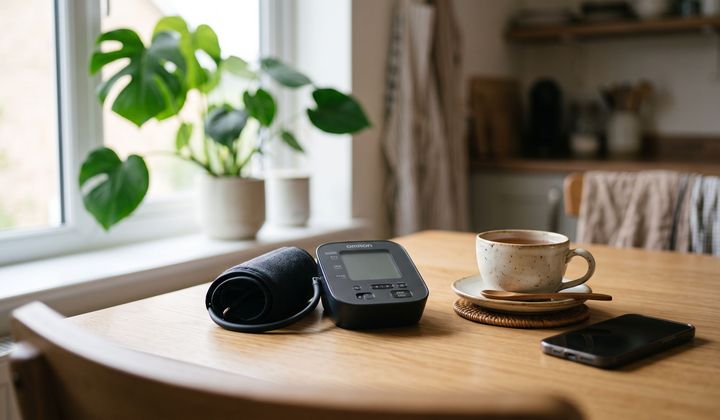
Praxisproblem Nummer eins ist die Messung selbst. Ein einzelner Wert beim Arzt hat wenig Aussagekraft. Häusliche Messungen über sieben Tage, morgens und abends, ergeben ein deutlich belastbareres Bild.
Kernaussagen
- Schon 5 mmHg dauerhafte Senkung verändern das Risiko messbar.
- Der Zusammenhang ist linear – es gibt keine harmlose Schwelle darunter.
- Sieben-Tage-Heimmessung schlägt jeden Einzelwert in der Praxis.
 Vertiefen Was bedeutet es, wenn mein Blutdruck mal 125, mal 150 ist?
  Nächster Schritt Bringt es etwas, den Blutdruck zu Hause zu messen und an die Praxis zu übermitteln?
  Querverbindung Welcher Blutwert verrät ein erbliches Gefäßrisiko zusätzlich zum Blutdruck?
 Ähnliche Beiträge




Belege (3)
Open-Access-Publikationen mit offener Lizenz, direkt verlinkt.
Targeting a systolic blood pressure of <130 mmHg is beneficial in adults with hypertension aged ≥75 years: a systematic review and meta-analysis
Abstract
Recent clinical trials have raised important questions regarding optimal blood pressure (BP) targets in older adults with hypertension. In the 2019 Japanese Society of Hypertension guidelines, a systolic BP (SBP) target of <140 mmHg is recommended for individuals aged ≥75 years. However, subsequent randomized controlled trials (RCTs) have shown potential cardiovascular and mortality benefits associated with strict BP targets. We conducted an updated systematic review and meta-analysis to evaluate the efficacy and safety of intensive SBP control (<130 mmHg) compared with less intensive control (≥130 mmHg) in patients with hypertension aged ≥75 years. We searched MEDLINE, Cochrane Library, and Ichushi Web for publications up to May 30, 2024, supplemented by manual searches. Seven RCTs that met predefined eligibility criteria were included in the final meta-analysis. Among patients aged ≥75 years, intensive SBP lowering was associated with significantly reduced risks of composite cardiovascular events (risk ratio [RR]: 0.61, 95% confidence interval [CI]: 0.40-0.94, p = 0.03), all-cause mortality (RR: 0.72, 95% CI: 0.56-0.93, p = 0.01), and cardiovascular mortality (RR: 0.55, 95% CI: 0.35-0.88, p = 0.01), with no increase in serious adverse events (RR: 1.00, 95% CI: 0.93-1.08, p = 0.97). Stroke incidence did not differ significantly between groups. Similar results were observed when the analysis was expanded to include studies that enrolled participants aged ≥70 years. These find
Blood pressure lowering in isolated diastolic hypertension and cardiovascular risk: an individual patient data meta-analysis
Abstract
<h4>Background and aims</h4>Blood pressure (BP) lowering reduces cardiovascular disease (CVD) risk; however, the benefits of treating patients with normal systolic BP but elevated diastolic BP remain uncertain.<h4>Methods</h4>Data from 51 randomized controlled trials were pooled to compare BP-lowering effects in participants with and without isolated diastolic hypertension (IDH), defined as systolic BP < 130 mmHg and diastolic BP ≥ 80 mmHg. Treatment effects were stratified across baseline diastolic BP categories (range < 60 to ≥90 mmHg) among individuals with baseline systolic BP < 130 mmHg. Fixed-effect one-stage individual participant data meta-analyses were used, and Cox proportional hazard models, stratified by trial, were applied to analyse the data.<h4>Results</h4>Among 358 325 participants, 15 845 (4.4%) had IDH. At a median follow-up of 4.2 years, a 5 mmHg reduction in systolic BP reduced the risk of major cardiovascular events similarly in individuals with IDH [hazard ratio 0.91; 95% confidence interval (CI) 0.82-1.01] and those without IDH (hazard ratio 0.90; 95% CI 0.89-0.92; P for interaction = 1.00). Analyses by baseline diastolic BP showed no evidence of heterogeneity in treatment effects among individuals with baseline systolic BP < 130 mmHg (P for interaction = .26). Relative treatment effects were not statistically different by CVD history, age, prior medication use, and BP measurement methods.<h4>Conclusions</h4>The study found no evidence to suggest that p
Exercise blood pressure relative to fitness and cardiovascular outcomes: the EXERTION study
Abstract
<h4>Background and aims</h4>A hypertensive response to exercise is independently associated with cardiovascular disease (CVD), but clinical interpretation may be confounded by aerobic capacity (fitness). The aim of this study was to determine the relationship between exercise blood pressure (BP) relative to fitness and CVD events.<h4>Methods</h4>Clinical exercise test records were analysed from 12 743 people (aged 53 ± 13 years, 60% male) who completed a standard exercise stress test (Bruce treadmill protocol, stages 1-4) at six Australian hospitals. Records were linked to administrative datasets (hospital and emergency admissions, death register) to define clinical characteristics and the primary outcome of fatal/non-fatal CVD events. Exercise systolic BP relative to fitness was calculated from the quotient of systolic BP and peak METs (SBP/METPeak). Competing risks regression was undertaken to compare events across quartiles, at the 90th percentile, and at various thresholds of SBP/METPeak.<h4>Results</h4>Over a median follow-up of 51 months (interquartile range: 32-75 months), 1349 events occurred. Exercise systolic BP without consideration of fitness was not associated with cardiovascular events (P > .05). In models adjusted for age, sex, and pre-exercise systolic BP, there was a stepwise increase in cardiovascular events across SBP/METPeak quartiles at stages 1-3 and peak (fourth quarter hazard ratios [HR]: stage 1 HR 2.54, 95% confidence interval [CI] 2.08-3.12; stage 2
Quellen aus Europe PMC, ausschließlich CC0, CC BY oder CC BY-SA. Der redaktionelle Text ist eine eigene Formulierung, keine Übernahme aus den Originalarbeiten.
Medizinische Prüfung: Dr. med. Anna Reuter, Fachärztin für Innere Medizin, 10. Mai 2026.
Fehler gefunden oder eine Frage zum Beitrag? Wir prüfen jeden Hinweis gegen die Quellen.
Hinweis an den Leserservice