

Krafttraining ab 50: der unterschätzte Longevity-Faktor
Muskelmasse und Kraft sind unabhängige Prädiktoren für Selbstständigkeit im Alter.
Ab dem vierten Lebensjahrzehnt verliert der Körper ohne Gegensteuerung jährlich etwa ein Prozent Muskelmasse, jenseits der Sechzig beschleunigt sich der Prozess. Kraft geht dabei schneller verloren als Masse – ein wichtiger Unterschied, denn Kraft ist der bessere Prädiktor für Funktionsfähigkeit.
Griffkraft als Marker für Sterblichkeit
Griffkraft ist deshalb zu einem Standardmarker geworden: Sie ist einfach zu messen und korreliert in großen Kohorten sowohl mit Gesamtsterblichkeit als auch mit dem Risiko für Pflegebedürftigkeit.
Kraft bleibt bis ins hohe Alter trainierbar
Die gute Nachricht ist die Trainierbarkeit. Auch Menschen jenseits der Achtzig zeigen unter progressivem Widerstandstraining substanzielle Kraftzuwächse. Zwei Einheiten pro Woche reichen für den größten Teil des Effekts.
Kernaussagen
- Kraft sinkt schneller als Muskelmasse und sagt Funktionsfähigkeit besser voraus.
- Zwei Krafteinheiten pro Woche liefern den überwiegenden Teil des Nutzens.
- Griffkraft ist ein einfacher, gut validierter Verlaufsmarker.
 Vertiefen Wie steigere ich beim Krafttraining die Last, ohne dass die Gelenke leiden? Nächster Schritt Wie baue ich mein Krafttraining ab 50 auf, ohne die Gelenke zu überlasten?
 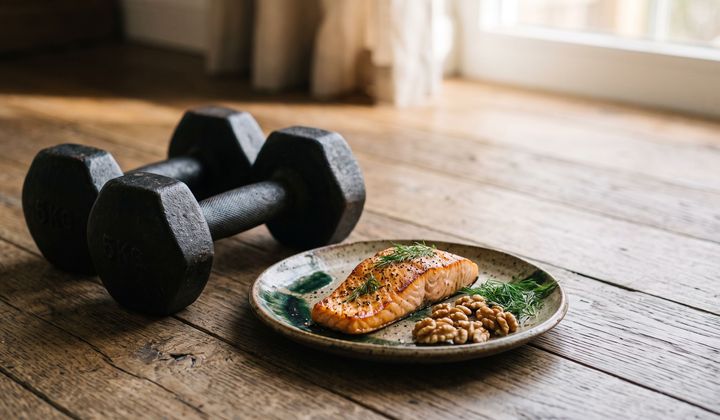 Querverbindung Bringt Fischöl zusätzlich zum Krafttraining etwas für die Muskeln?
 Ähnliche Beiträge




Belege (3)
Open-Access-Publikationen mit offener Lizenz, direkt verlinkt.
Influence of Resistance Training Variables to Improve Muscle Mass Outcomes in Sarcopenia: A Systematic Review With Meta-Regressions
Abstract
<h4>Background</h4>Resistance training (RT) is the first-line treatment to improve sarcopenia features. However, increasing muscle mass with RT remains challenging and displays inconsistent results. Manipulating training variables may present a novel approach to improve muscle mass gain in sarcopenic individuals. The present study aimed to measure the effectiveness of RT alone on muscle mass outcomes in older adults with sarcopenia and determine the influence of RT variables on muscle mass improvement.<h4>Method</h4>We conducted a systematic review according to PRISMA standards to gather studies that conducted a supervised RT without nutritional intervention in sarcopenia-diagnosed older adults with a muscle mass outcome versus a control group. A search strategy was performed on PubMed, Medline, Cochrane and Google Scholar in the last 14 years, from the publication of the first agreement on the diagnosis (EWGSOP, 2010). Along with sample characteristics, we extracted and analysed the following training variables: frequency (number of sessions per week), intensity (in rating perceived effort and in % of the one repetition maximal load), duration (weeks), volume (number of sets per week), periodization (yes/no) and muscle failure (yes/no). First, we standardized the outcome with Hedge's g and pooled the effect size (ES) of each study in a univariate meta-analysis adjusted for risk of bias. Then, we performed training composition comparisons between 'effective interventions' and
Effects of resistance training on muscle mass, strength, and physical function in older women with sarcopenia: a systematic review and meta-analysis
Abstract
<h4>Background and objective</h4>Resistance training is widely recommended for sarcopenia, yet evidence in older women remains limited. This study systematically evaluated its effects on muscle mass, strength, and physical function in this population.<h4>Methods</h4>PubMed, Embase, Web of Science, and the Cochrane Central Register of Controlled Trials were searched up to February 2025; the protocol was registered in PROSPERO (CRD420251066233). Meta-analyses were performed using the "meta" package in R under a random-effects model with restricted maximum likelihood estimation. Study quality was assessed using RoB 2, and evidence certainty via GRADE.<h4>Results</h4>Twelve randomized controlled trials involving 518 older women with sarcopenia were included. Resistance training significantly improved handgrip strength (SMD = 0.43, 95% CI: 0.11-0.74), gait speed (SMD = 0.37, 95% CI: 0.09 to 0.64), knee extension strength (SMD = 0.85, 95% CI: 0.37 to 1.33), Timed Up and Go (SMD = -0.68, 95% CI: -0.95 to -0.41), and 30-Second Chair Stand (SMD = 0.52, 95% CI: 0.19 to 0.86), but had no significant effect on skeletal muscle mass index. Subgroup analyses showed that women with sarcopenic obesity achieved greater gains in knee extension strength, while those with sarcopenia alone improved more in gait speed. Mixed resistance training demonstrated a significant advantage in enhancing gait speed.<h4>Conclusion</h4>Resistance training effectively enhances muscle strength and physical functi
Optimizing prescription of resistance training for body composition, muscle strength, and physical performance in older adults with sarcopenia: a systematic review and meta-analysis
Abstract
<h4>Objective</h4>This systematic review and meta-analysis aimed to address key gaps in understanding the role of resistance training (RT) as an intervention to mitigate age-related sarcopenia. Specifically, it examined: (i) effects on body composition and physical performance; (ii) moderating influences of age and training intensity; and (iii) the presence of a dose-response relationship within the FITT-VP framework.<h4>Methods</h4>A comprehensive search of multiple databases identified randomized controlled trials (RCTs) evaluating RT in older adults with sarcopenia. Data on body composition, muscle strength (MS), and functional performance were extracted. Moderator analyses assessed the impact of participant and intervention characteristics, and meta-regression was performed to explore dose-response patterns.<h4>Results</h4>Twenty-five RCTs involving 1,302 participants were included. RT produced significant improvements in MS (ES = 0.71), lean mass (LM, [ES = 0.22]), fat mass (FM, [ES = - 0.17]), walking ability (WA, [ES = 0.41]), grip strength ([GS, [ES = 0.55]), muscle quality (MQ, [ES = 1.25]) (all p < 0.05), but this large effect size was based on only two studies and requires caution interpretation. Dose-response meta-regression revealed a significant non-linear relationship between total RT duration and functional gains, with optimal estimated cumulative volumes of ~ 2,716 min for WA.<h4>Conclusion</h4>RT is a robust, evidence-based strategy for enhancing MS, functio
Quellen aus Europe PMC, ausschließlich CC0, CC BY oder CC BY-SA. Der redaktionelle Text ist eine eigene Formulierung, keine Übernahme aus den Originalarbeiten.
Medizinische Prüfung: Dr. med. Anna Reuter, Fachärztin für Innere Medizin, 24. Juli 2026.
Fehler gefunden oder eine Frage zum Beitrag? Wir prüfen jeden Hinweis gegen die Quellen.
Hinweis an den Leserservice