
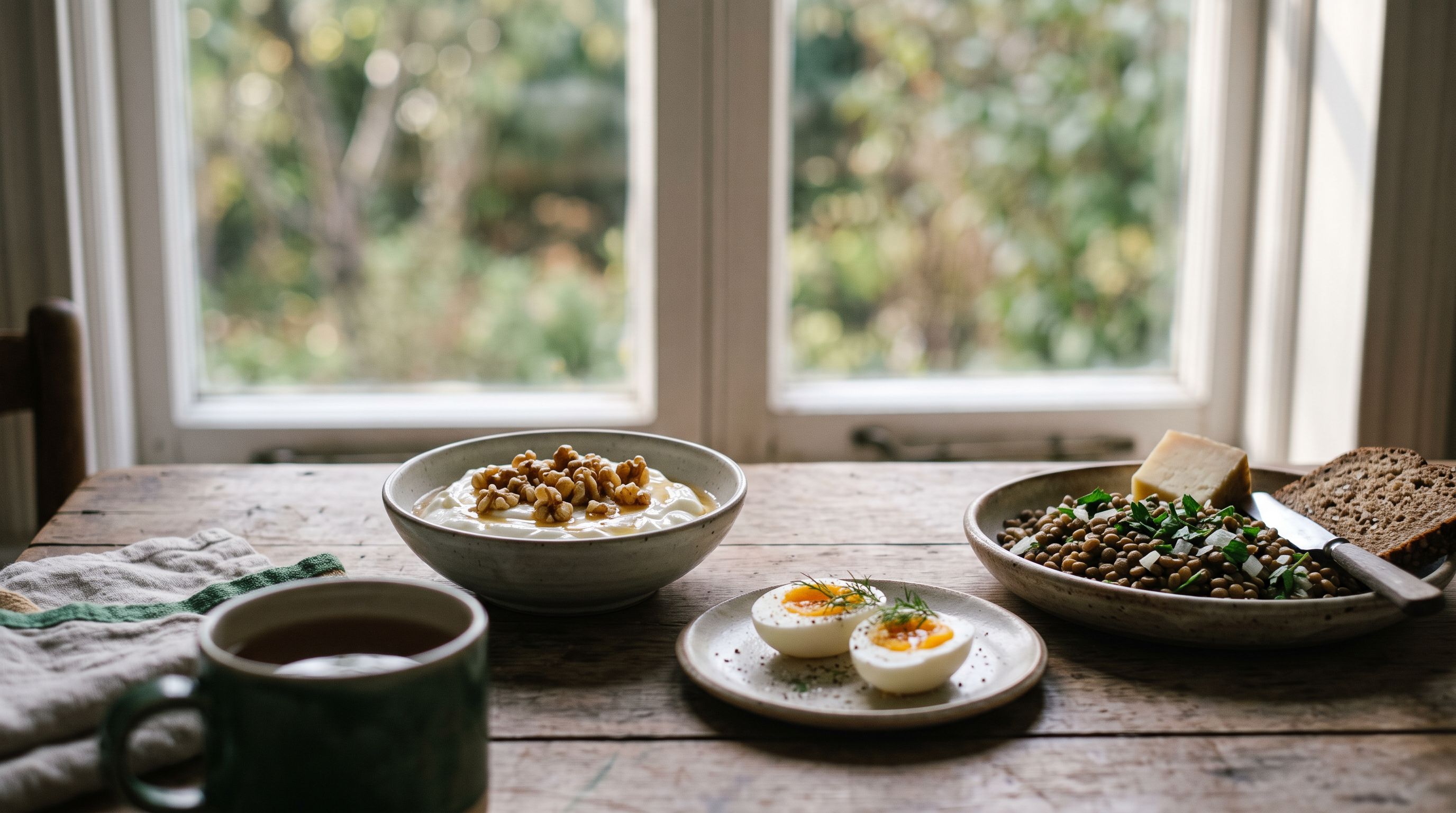
Wie viel Protein braucht man ab 50 wirklich?
Die offiziellen Referenzwerte sind für Muskelerhalt im Alter zu niedrig angesetzt.
Die klassische Referenzzufuhr von 0,8 Gramm Protein pro Kilogramm Körpergewicht wurde abgeleitet, um Mangelzustände zu vermeiden – nicht, um Muskelmasse im Alter zu erhalten. Für dieses Ziel liegen die in Interventionsstudien untersuchten Mengen deutlich höher.
Warum ältere Muskeln mehr Protein brauchen
Hintergrund ist die anabole Resistenz: Ältere Muskulatur reagiert auf dieselbe Proteinmenge schwächer mit Muskelproteinsynthese als junge. Die Schwelle pro Mahlzeit steigt entsprechend.
Protein über den Tag verteilen
In der Praxis heißt das: nicht nur mehr Protein insgesamt, sondern besser verteilt. Drei bis vier Mahlzeiten mit jeweils substanziellem Proteinanteil schlagen eine große Portion am Abend.
Kernaussagen
- Die Referenzwerte zielen auf Mangelvermeidung, nicht auf Muskelerhalt.
- Anabole Resistenz erhöht die nötige Proteinmenge pro Mahlzeit.
- Verteilung über den Tag ist ähnlich wichtig wie die Gesamtmenge.
 Vertiefen Leidet die Muskelkraft, wenn ich Fleisch durch pflanzliches Eiweiß ersetze?
  Nächster Schritt Reicht es, mehr Eiweiß zu essen, oder brauche ich auch Krafttraining?
  Querverbindung Wie bekomme ich beim Intervallfasten genug Eiweiß zusammen?
 Ähnliche Beiträge
Belege (3)
Open-Access-Publikationen mit offener Lizenz, direkt verlinkt.
Association of Protein Intake with Sarcopenia and Related Indicators Among Korean Older Adults: A Systematic Review and Meta-Analysis
Abstract
<h4>Objectives</h4>Due to variations in the standards for optimal protein intake and conflicting results across studies for Korean older adults, this study aimed to quantitatively integrate existing research on the association of protein intake with sarcopenia and related indicators in Koreans aged 65 and older through meta-analysis.<h4>Methods</h4>A total of 23 studies were selected according to the study selection criteria (PICOS). Sixteen cross-sectional studies, 5 randomized controlled trials (RCTs), and 2 non-RCTs were included in the review, with 9 out of 23 studies included in the meta-analysis. We used fixed-effects models and performed subgroup and sensitivity analyses.<h4>Results</h4>A meta-analysis found that the risk of sarcopenia was significantly higher in the <0.8 g/kg/day protein intake group compared to the 0.8-1.2 g/kg/day and ≥1.2 g/kg/day groups, with odds ratios (ORs) of 1.25 (95% confidence interval (CI), 1.10 to 1.42; <i>I</i><sup>2</sup> = 55%) and 1.79 (95% CI, 1.53 to 2.10; <i>I</i><sup>2</sup> = 71%), respectively. For low hand grip strength (HGS), the risk was higher in the <0.8 g/kg/day group compared to the 0.8-1.2 g/kg/day or ≥1.2 g/kg/day groups (OR 1.31; 95% CI, 1.03 to 1.65; <i>I</i><sup>2</sup> = 28%). No significant associations were found with other sarcopenia indicators, such as skeletal muscle mass, short physical performance battery score, balance test, gait speed, and timed up-and-go test.<h4>Conclusions</h4>Lower protein intake is ass
Dietary Protein and Physical Exercise for the Treatment of Sarcopenia
Abstract
Sarcopenia is a multifactorial age-related disorder that causes a decrease in muscle mass, strength, and function, leading to alteration of movement, risk of falls, and hospitalization. This article aims to review recent findings on the factors underlying sarcopenia and the strategies required to delay and counteract its symptoms. We focus on molecular factors linked to ageing, on the role of low-grade chronic and acute inflammatory conditions such as cancer, which contributes to the onset of sarcopenia, and on the clinical criteria for its diagnosis. The use of drugs against sarcopenia is still subject to debate, and the suggested approaches to restore muscle health are based on adequate dietary protein intake and physical exercise. We also highlight the difference in the amount and quality of amino acids within animal- and plant-based diets, as studies have often shown varying results regarding their effect on sarcopenia in elderly people. In addition, many studies have reported that non-pharmacological approaches, such as an optimization of dietary protein intake and training programs based on resistance exercise, can be effective in preventing and delaying sarcopenia. These approaches not only improve the maintenance of skeletal muscle function, but also reduce health care costs and improve life expectancy and quality in elderly people.
Role of protein intake in maintaining muscle mass composition among elderly females suffering from sarcopenia
Abstract
Dietary protein is crucial in preserving muscle mass and promoting long-term bone health, particularly in aging populations. The novelty of this study lies in evaluating the impact of varying protein intake levels (0.8 vs. 1.2 g/kg b.w/d) on muscle mass composition in elderly females suffering from sarcopenia. For this purpose, in this research trial, a total of 126 participants (60-75 years) were enrolled and equally divided into two groups: normal protein intake (0.8 g/kg b.w/d) and moderately high protein intake (1.2 g/kg b.w/d) for 12 weeks. The effects of dietary protein were assessed using anthropometric measurements, magnetic resonance imaging (MRI), handgrip, and knee flexion tests with baseline and post-intervention comparisons. Statistical analysis was conducted using SPSS, employing paired sample t-test at a significance level of <i>p</i> < 0.05. Results indicated a significant improvement in muscle mass composition with moderately high protein intake. Anthropometric parameters, including body mass (83.51 ± 4.23 kg) and waist circumference (113.90 ± 10.82 cm), showed notable enhancement in the moderately higher protein group. Muscle function and imaging assessments, such as handgrip strength and knee flexion, demonstrated improved functionality. MRI-derived measurements of the muscle composition of the calf (141.23 ± 4.87 MCSA, mm<sup>2</sup> × 10<sup>4</sup>) and thigh (258.04 ± 7.26 MCSA, mm<sup>2</sup> × 10<sup>4</sup>) further confirmed the positive impact of i
Quellen aus Europe PMC, ausschließlich CC0, CC BY oder CC BY-SA. Der redaktionelle Text ist eine eigene Formulierung, keine Übernahme aus den Originalarbeiten.
Medizinische Prüfung: Dr. med. Anna Reuter, Fachärztin für Innere Medizin, 30. Juni 2026.
Fehler gefunden oder eine Frage zum Beitrag? Wir prüfen jeden Hinweis gegen die Quellen.
Hinweis an den Leserservice