
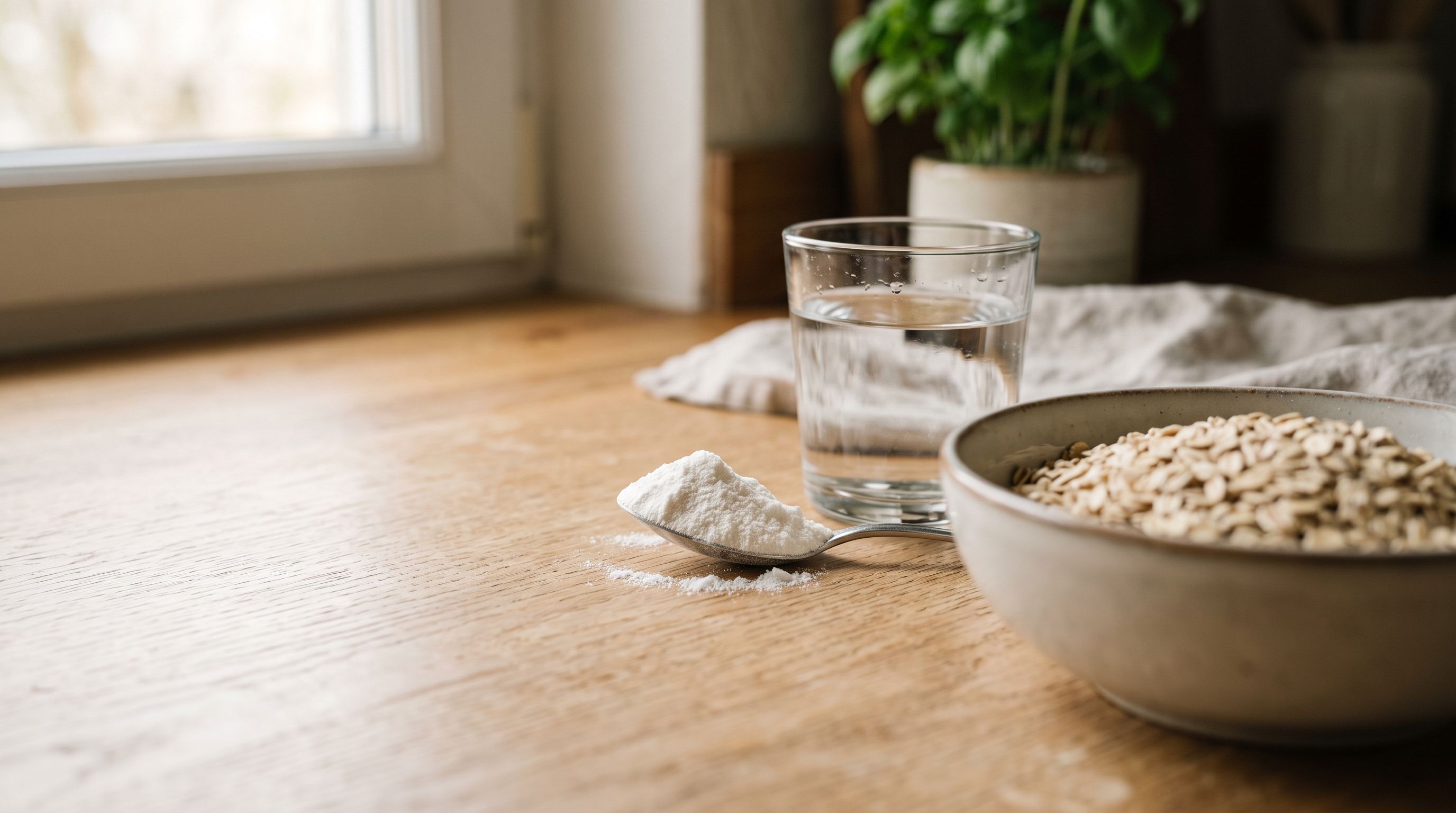
Kreatin: Dosierung, Einnahme und für wen es nicht passt
In Studien sind 3 bis 5 Gramm Kreatin-Monohydrat am Tag üblich, der Zeitpunkt spielt kaum eine Rolle. Die wichtigsten Fragen zu Ladephase, Nebenwirkungen und Gegenanzeigen.
Für Kreatin-Monohydrat sind 3 bis 5 Gramm am Tag die übliche Dosis, laut einer internationalen Expertenübersicht von 2025. Der Zeitpunkt der Einnahme spielt danach kaum eine Rolle. Entscheidend ist, es regelmäßig zu nehmen und mit Training zu verbinden.
Wie viel und in welcher Form?
Greifen Sie zu Kreatin-Monohydrat. In einer Metaanalyse von 2024 mit 16 randomisierten Studien war es die einzige untersuchte Form. Die nach eigenen Angaben bis dahin größte Studie zur geistigen Leistung mit 123 Teilnehmenden gab 5 Gramm täglich über sechs Wochen.
Den größten Nutzen für Ältere sieht laut einer Übersichtsarbeit von 2025 die Kombination mit Training. Dann verbesserten sich in Studien Muskelmasse, Kraft und Alltagsfunktion. Die Expertengruppe hält einen gewissen Nutzen für die Muskulatur auch ohne Training für möglich.
Brauche ich eine Ladephase?
Eine Ladephase füllt die Speicher schneller. Laut der Diskussion einer Studie von 2024 erhöhen etwa 20 Gramm täglich über rund vier Tage die Phosphokreatin-Speicher im Muskel um etwa 6 Prozent. In einer kleinen Studie mit 30 jungen Erwachsenen meldeten allerdings nur Teilnehmende mit 20 Gramm täglich Blähungen oder Völlegefühl.
Wer Magenprobleme vermeiden will, kann auf die Ladephase verzichten. Laut der Expertenübersicht ist die regelmäßige Einnahme während eines Trainingsprogramms die wichtigste Größe.
Den Zeitpunkt können Sie frei wählen. Zusammen mit Kohlenhydraten oder Eiweiß, also zu einer Mahlzeit, steigen die Speicher laut der Übersicht womöglich schneller. Kaffee hebt die Wirkung kurzfristig wohl nicht auf, solange laut Übersicht die Koffeinmenge unter 5 Milligramm je Kilogramm Körpergewicht am Tag bleibt.
Wirkt Kreatin bei jedem?
Nein. Laut der Diskussion der Studie von 2024 sprechen schätzungsweise rund 30 Prozent der Menschen auf eine Ladephase nicht mit volleren Speichern an. Wer wenig Kreatin mit der Nahrung aufnimmt, etwa vegetarisch oder vegan, reagiert laut der Expertenübersicht womöglich stärker. Bei der geistigen Leistung fand die Studie mit 123 Teilnehmenden allerdings keinen größeren Nutzen für Vegetarier.
Geduld gehört dazu. In einer randomisierten Studie mit 19 Brustkrebs-Überlebenden veränderten sieben Tage Kreatin die Muskelleistung nicht.
Welche Nebenwirkungen sind bekannt?
In der Studie mit 123 Teilnehmenden meldeten Personen unter Kreatin signifikant häufiger Nebenwirkungen als unter Placebo. Mehrere verbreitete Befürchtungen bestätigt die Expertenübersicht dagegen nicht. Kreatin erhöht danach nicht die Urinmenge, und es gibt keine Hinweise auf einen negativen Einfluss auf den Blutdruck. Ein erhöhtes Krebsrisiko sieht die Übersicht laut ihrem Fazit bei 3 bis 5 Gramm täglich ebenfalls nicht.
Kreatin treibt die Urinmenge und den Blutdruck in die Höhe.
Für wen passt Kreatin nicht ohne Rücksprache?
Schwangere: Laut der Expertenübersicht gibt es keine gut gemachten randomisierten Studien zur Sicherheit in der Schwangerschaft. Tierdaten allein reichen nicht für eine Entwarnung.
Menschen mit Nieren- oder Lebererkrankungen: Die hier ausgewerteten Studien beantworten diese Frage nicht. Sprechen Sie vor der Einnahme mit Ihrer Ärztin oder Ihrem Arzt.
Menschen in oder nach einer Krebstherapie: Die Expertenübersicht hält Kreatin hier für womöglich hilfreich. Laut einer Studie von 2024 ist die Datenlage für Krebspatienten aber noch lückenhaft. Stimmen Sie die Einnahme mit dem Behandlungsteam ab.
Wer viele Medikamente nimmt oder mehrere Vorerkrankungen hat, sollte ebenfalls vorher ärztlichen Rat einholen.
Ihr Kurz-Check
1. Produkt: reines Kreatin-Monohydrat, die in den Studien verwendete Form.
2. Menge: laut Expertenübersicht 3 bis 5 Gramm täglich, gern zu einer Mahlzeit.
3. Begleitung: regelmäßiges Krafttraining, denn laut Übersichtsarbeit zeigt sich der Nutzen bei Älteren vor allem in dieser Kombination.
4. Geduld: Bewerten Sie die Wirkung nicht nach einer Woche, sondern nach einigen Wochen Training.
5. Rücksprache: bei Schwangerschaft, Nieren-, Leber- oder Krebserkrankung und vielen Medikamenten vorher ärztlich klären.
Kernaussagen
- Üblich sind 3 bis 5 Gramm Kreatin-Monohydrat täglich; der Zeitpunkt spielt laut einer Expertenübersicht kaum eine Rolle.
- Eine Ladephase mit 20 Gramm füllt die Speicher schneller, kann aber Blähungen und Völlegefühl auslösen.
- Rund 30 Prozent der Menschen sprechen auf eine Ladephase womöglich nicht an.
- In der Schwangerschaft sowie bei Nieren-, Leber- oder Krebserkrankungen nur nach ärztlicher Rücksprache.
 Vertiefen Was bringt Kreatin Älteren überhaupt an Kraft und Muskelmasse?
  Nächster Schritt Woran merke ich, ob mein Krafttraining wirklich Fortschritte bringt?
  Querverbindung Wie viel Eiweiß brauche ich ab 50, um Muskeln zu erhalten?
 Ähnliche Beiträge




Belege (6)
Open-Access-Publikationen mit offener Lizenz, direkt verlinkt.
Part II. Common questions and misconceptions about creatine supplementation: what does the scientific evidence really show?
Abstract
Creatine monohydrate supplementation (CrM) is a safe and effective intervention for improving certain aspects of sport, exercise performance, and health across the lifespan. Despite its evidence-based pedigree, several questions and misconceptions about CrM remain. To initially address some of these concerns, our group published a narrative review in 2021 discussing the scientific evidence as to whether CrM leads to water retention and fat accumulation, is a steroid, causes hair loss, dehydration or muscle cramping, adversely affects renal and liver function, and if CrM is safe and/or effective for children, adolescents, biological females, and older adults. As a follow-up, the purpose of this paper is to evaluate additional questions and misconceptions about CrM. These include but are not limited to: 1. Can CrM provide muscle benefits without exercise? 2. Does the timing of CrM really matter? 3. Does the addition of other compounds with CrM enhance its effectiveness? 4. Does CrM and caffeine oppose each other? 5. Does CrM increase the rates of muscle protein synthesis or breakdown? 6. Is CrM an anti-inflammatory intervention? 7. Can CrM increase recovery following injury, surgery, and/or immobilization? 8. Does CrM cause cancer? 9. Will CrM increase urine production? 10. Does CrM influence blood pressure? 11. Is CrM safe to consume during pregnancy? 12. Does CrM enhance performance in adolescents? 13. Does CrM adversely affect male fertility? 14. Does the brain require a hig
The effects of creatine supplementation on cognitive function in adults: a systematic review and meta-analysis
Abstract
<h4>Background</h4>This study aimed to evaluate the effects of creatine monohydrate supplementation on cognitive function in adults and explore its potential role in preventing and delaying cognitive impairment-related diseases.<h4>Methods</h4>Following the PRISMA 2020 guidelines, a systematic review with meta-analysis was conducted. Randomized controlled trials (RCTs) published between 1993 and 2024 were retrieved from PubMed, Scopus, and Web of Science databases. The study protocol was registered with PROSPERO (registration number: CRD42024533557). The impact of creatine supplementation on overall cognitive function, memory, executive function, attention, and information processing speed was assessed using standardized mean differences (SMD) and Hedge's g with 95% confidence intervals (CI).<h4>Results</h4>Sixteen RCTs involving 492 participants aged 20.8-76.4 years, including healthy individuals and patients with specific diseases, were selected. Creatine monohydrate was the form used in all included studies. Creatine supplementation showed significant positive effects on memory (SMD = 0.31, 95% CI: 0.18-0.44, Hedges's <i>g</i> = 0.3003, 95% CI: 0.1778-0.4228) and attention time (SMD = -0.31, 95% CI: -0.58 to -0.03, Hedges's <i>g</i> = -0.3004, 95% CI: -0.5719 to -0.0289), as well as significantly improving processing speed time (SMD = -0.51, 95% CI: -1.01 to -0.01, Hedges's <i>g</i> = -0.4916, 95% CI: -0.7852 to -0.1980). However, no significant improvements were found on
The effects of creatine supplementation on cognitive performance-a randomised controlled study
Abstract
<h4>Background</h4>Creatine is an organic compound that facilitates the recycling of energy-providing adenosine triphosphate (ATP) in muscle and brain tissue. It is a safe, well-studied supplement for strength training. Previous studies have shown that supplementation increases brain creatine levels, which might increase cognitive performance. The results of studies that have tested cognitive performance differ greatly, possibly due to different populations, supplementation regimens, and cognitive tasks. This is the largest study on the effect of creatine supplementation on cognitive performance to date.<h4>Methods</h4>Our trial was preregistered, cross-over, double-blind, placebo-controlled, and randomised, with daily supplementation of 5 g for 6 weeks each. We tested participants on Raven's Advanced Progressive Matrices (RAPM) and on the Backward Digit Span (BDS). In addition, we included eight exploratory cognitive tests. About half of our 123 participants were vegetarians and half were omnivores.<h4>Results</h4>Bayesian evidence supported a small beneficial effect of creatine. The creatine effect bordered significance for BDS (p = 0.064, η<sup>2</sup><sub>P</sub> = 0.029) but not RAPM (p = 0.327, η<sup>2</sup><sub>P</sub> = 0.008). There was no indication that creatine improved the performance of our exploratory cognitive tasks. Side effects were reported significantly more often for creatine than for placebo supplementation (p = 0.002, RR = 4.25). Vegetarians did not ben
Creatine monohydrate supplementation for older adults and clinical populations
Abstract
<h4>Background</h4>The biological process of aging is typically associated with a decrease in muscle quantity, muscle performance (primarily strength), bone mass and architecture, functionality and neurological/cognitive function. From a healthy aging perspective, interventions that have the potential to overcome or attenuate these decrements are clinically relevant.<h4>Methods</h4>We conducted a narrative review on the efficacy of creatine monohydrate supplementation (CrM) in older adults.<h4>Results</h4>Accumulating research shows that CrM, primarily when combined with exercise training, is safe and has beneficial effects on measures of whole-body lean body mass, regional muscle size, muscle strength, bone area and thickness, functional ability, glucose kinetics, cognition and memory.<h4>Conclusion</h4>CrM has multiple benefits in older adults and may have application for treating age-related sarcopenia, osteoporosis, frailty, and those with metabolic and neuromuscular disorders.
Impact of Short-Term Creatine Supplementation on Muscular Performance among Breast Cancer Survivors
Abstract
Breast cancer (BC) is one of the most common cancers in the United States. Advances in detection and treatment have resulted in an increased survival rate, meaning an increasing population experiencing declines in muscle mass and strength. Creatine supplementation has consistently demonstrated improvements in strength and muscle performance in older adults, though these findings have not been extended to cancer populations.<h4>Purpose</h4>The purpose of this study was to investigate the effects of short-term creatine supplementation on muscular performance in BC survivors.<h4>Methods</h4>Using a double-blind, placebo-controlled, randomized design, 19 female BC survivors (mean ± SD age = 57.63 ± 10.77 years) were assigned to creatine (SUPP) (<i>n</i> = 9) or dextrose placebo (PLA) (<i>n</i> = 10) groups. The participants completed two familiarization sessions, then two test sessions, each separated by 7 days, where the participants supplemented with 5 g of SUPP or PLA 4 times/day between sessions. The testing sessions included sit-to-stand power, isometric/isokinetic peak torque, and upper/lower body strength via 10 repetition maximum (10RM) tests. The interaction between supplement (SUPP vs. PLA) and time (Pre vs. Post) was examined using a group × time ANOVA and effect sizes.<h4>Results</h4>No significant effects were observed for sit-to-stand power (<i>p</i> = 0.471; η<sub>p</sub><sup>2</sup> = 0.031), peak torque at 60°/second (<i>p</i> = 0.533; η<sub>p</sub><sup>2</sup> =
Dose-Response of Creatine Supplementation on Cognitive Function in Healthy Young Adults
Abstract
To determine if creatine (Cr) supplementation could influence cognitive performance and whether any changes were related to changes in prefrontal cortex (PFC) activation during such cognitive tasks, thirty (M = 11, F = 19) participants were evenly randomized to receive supplementation with Cr (CR10:10 g/day or CR20:20 g/day) or a placebo (PLA:10 g/day) for 6 weeks. Participants completed a cognitive test battery (processing speed, episodic memory, and attention) on two separate occasions prior to and following supplementation. Functional near-infrared spectroscopy (fNIRS) was used to measure PFC oxyhemoglobin (O<sub>2</sub>Hb) during the cognitive evaluation. A two-way repeated measures ANOVA was used to determine the differences between the groups and the timepoints for the cognitive performance scores and PFC O<sub>2</sub>Hb. In addition, a one-way ANOVA of % change was used to determine pre- and post-differences between the groups. Creatine (independent of dosage) had no significant effect on the measures of cognitive performance. There was a trend for decreased relative PFC O<sub>2</sub>Hb in the CR10 group versus the PLA group in the processing speed test (<i>p</i> = 0.06). Overall, six weeks of Cr supplementation at a moderate or high dose does not improve cognitive performance or change PFC activation in young adults.
Quellen aus Europe PMC, ausschließlich CC0, CC BY oder CC BY-SA. Der redaktionelle Text ist eine eigene Formulierung, keine Übernahme aus den Originalarbeiten.
Medizinische Prüfung: Dr. med. Anna Reuter, Fachärztin für Innere Medizin, 21. September 2026.
Fehler gefunden oder eine Frage zum Beitrag? Wir prüfen jeden Hinweis gegen die Quellen.
Hinweis an den Leserservice